
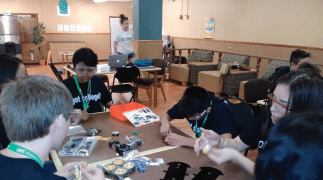
How do you get a teenager out of bed at 7 a.m. during the summertime? For a group of 12 soon-to-be high school freshmen, the answer came in the form of an all-expenses paid, weeklong STEM summer camp at the University of North Texas (UNT) this past July. In in its third year, the Summer Science Institute (SSI) is a collaboration between UNT’s Talent Search program, the Texas Academy of Math and Science (TAMS), and Strickland Middle School in Denton, TX.
Strickland’s student population is 70% free and reduced lunch and a sizable portion of the student body are potential first-generation college students. Although college is something they would like to do, many lack the knowledge base or the resources to make college a viable option. According to UNT Talent Search Director Beverly Maloney, these demographics provided the perfect setting for the Talent Search. This federally funded program aims to not only inform middle and high school students about college, but to have students visit and actively engage in programs at universities (Talent Search Program, 2018). Maloney collaborated with Christina Dearman, GT Specialist at Strickland, to specifically target gifted and high-ability students, working jointly to better address and engage this population in college readiness. The convenience of Talent Search and TAMS being housed at UNT spearheaded conversations with TAMS Academic Advisors Samuel Earls and Wendy Boyd-Brown. TAMS, a STEM early college entrance residential program for gifted high school students, challenges its students to contribute meaningfully to the world, including the Denton community (Texas Academy of Mathematics & Science, 2018). These components, along with the strong participation of students at Strickland, launched the implementation of SSI.
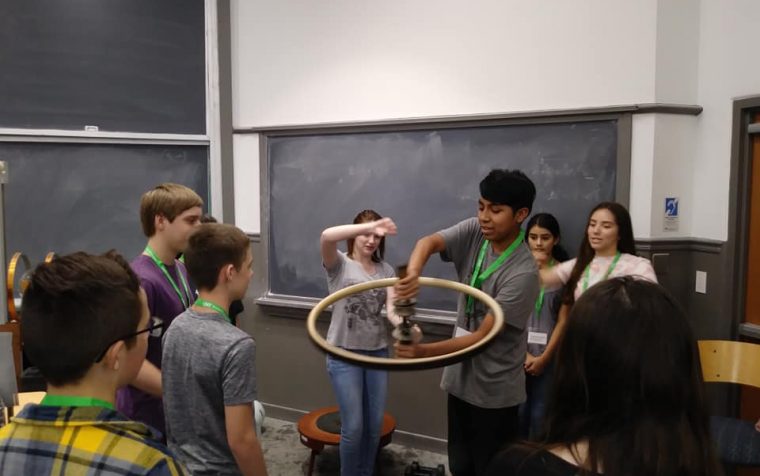
Scheduled by Boyd-Brown, the weeklong program provided students with inside looks at labs and classrooms. In one lab, students participated in Scratch programming, while in another they investigated Newton’s Laws as applied to magnetism. At the Human Language Technologies lab, students experimented with NAO Robots and programming with Choreographer. Students also tested their skills at laser cutting and 3D printing. A visit to the planetarium resulted in discussions about water below the surface of Mars and a tour of the Zero Energy Lab had students thinking about future ecological challenges. The week was capped off with a field trip to the Perot Museum in Dallas where students tested their own speeds in the Sports Hall and took a ride deep into the Barnett Shale.
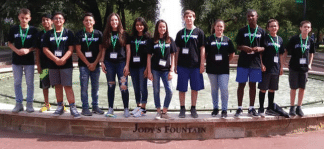
Current TAMS students served as mentors and former Talent Search graduate, current UNT student Javiera Sanchez-Ruiz, served as counselor to the students for the week. SSI participants were able to visit with them and get the “real answers” about college life. An important aspect of college life and a highlight of the week was the “daily dining” at the residence hall.
Feedback from the SSI students indicates that the weeklong experience will continue to pique interest in STEM, as well as college. Diego reported that he discovered a more creative side in himself and his desire to design in Video Remote Interpreting (VRI) is now a reality. In addition, he previously found the thought of college as “scary, but if you come to this environment you find out that it isn’t.” Samantha commented that although she had considered college, she feels more likely to attend. She appreciated her mentors most because they “help you succeed and [know that] you aren’t going through it on your own.” Parents noted that their students were motivated to attend SSI and shared that many conversations were had about going to college, about science, and about different careers in science. Finally, when asked if she had attended SSI or any other summer programs, participant Esmeralda replied, “No, because I have never really had someone to help me find these opportunities.” She went on to comment that by going to SSI she now “realized (college) is not that scary and it’s kinda welcoming” and that the SSI program gave her “a good opportunity to look forward to the future.”
References
Texas Academy of Mathematics & Science. (n.d.). Community service. Retrieved from https://tams.unt.edu/studentlife/community-service
Talent Search Program. (2018, March 01). Federal TRIO programs. Retrieved from https://www2.ed.gov/programs/triotalent/index.html
Christina T. Dearman, Ph.D., serves as clinical assistant professor and the Pathway for Future Teachers Coordinator at the University of North Texas. With over 20 years in education, she has taught in various capacities at the Pre-K through secondary level, serving as an honors teacher and GT specialist. She has also had the opportunity to run school wide and Saturday enrichment programs, served as Curriculum Director for UNT’s Texas Governor’s School, and has taught various education courses at the undergraduate and graduate levels. Dr. Dearman currently serves as Treasurer for the Texas Association for the Gifted and Talented and sits on the Texas Academy of Math and Science Advisory Board.