


Mathematics proficiency scores show the lingering effects of the learning loss students experienced during the 2019-2020 school year. While mathematics performance levels overall have rebounded, the percentage of third grade students scoring at the Masters Level on the Grade 3 STAAR Mathematics test decreased from 30% in 2022 to 19% in 2023 (Texas Education Agency, 2023). This data indicates an opportunity to provide rigorous learning experiences for students in elementary mathematics. As students progress through elementary school, the complexity of the learning standards requires the mastery of computational, conceptual, analytical, and problem-solving skills. Rigor in the mathematics classroom involves creating learning environments that nurture and develop these skills in students with varying levels of mathematical fluency.
Introducing Differentiated Choice Boards
Pre-Assess: Administer a pre-assessment to the entire class at the beginning of the unit or week. If a student shows mastery (e.g., 85%) before receiving instruction on the unit, offer the student differentiated activities.
Set Expectations: Prior to assigning a choice board, determine the expectations you have for students. For example, teachers may decide that students must complete each activity, but they can choose the order of completion. Teachers may also decide that students can choose which activities to complete (e.g., pick three in a row, choose five).
Flexibility: There are many ways to flexibly use choice boards in elementary classrooms. For example, the boards can have a blend of independent and partner work. As teachers create TEKS-aligned activities, they can easily adjust the level of difficulty in independent or partner work to meet the needs of each student. In multiple ability classrooms, this can include scaffolded activities for intervention, on-level instruction, enrichment, or blended learning. Choice boards can be printed or digital copies can be loaded in learning management platforms, such as Google Classroom. These boards also provide opportunities for formative assessment.
Choice Board Example and Standards Alignment
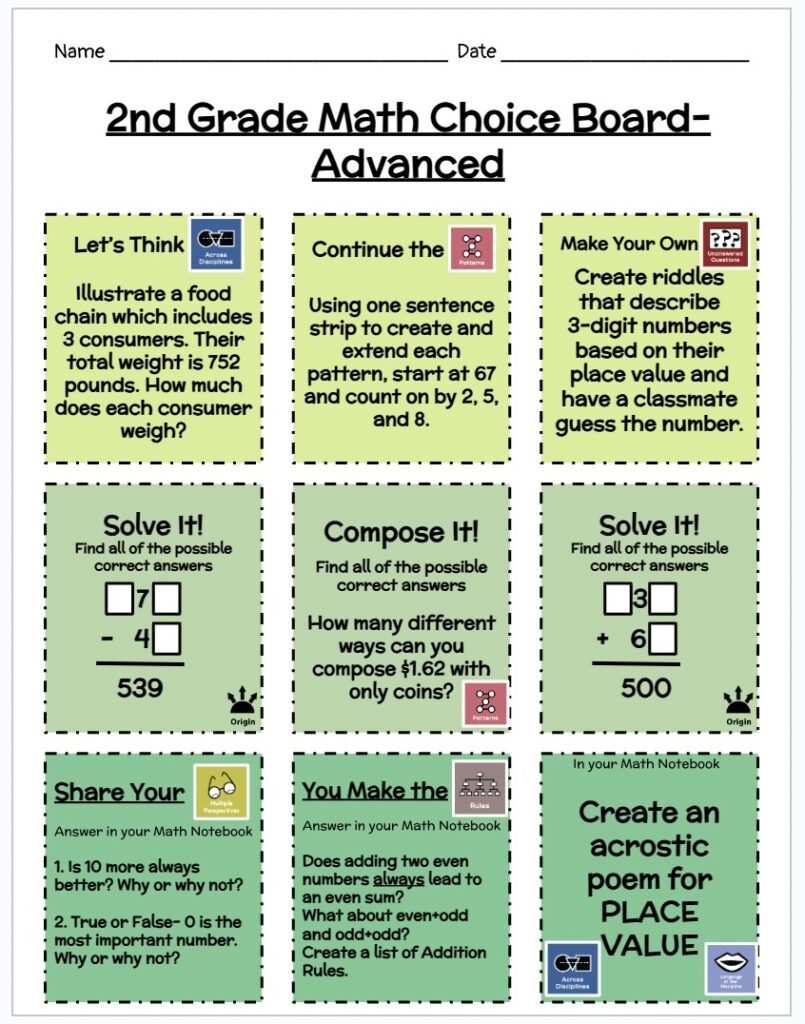
Choice board activities, like the one included in this resource, provide an instructional tool teachers can implement to create customized learning experiences. The following choice board integrates hands-on mathematics activities to differentiate instruction for advanced learners in second grade math. This sample board incorporates the depth and complexity icons (“Depth and complexity icons,” 2024). This resource aligns with the Texas State Plan for the Education of Gifted/Talented Students (Texas Education Agency [TEA], 2019) Curriculum and Instruction Accountability Standard 4.1, which notes that students should be provided “an array of appropriately challenging learning experiences in each of the four (4) foundation curricular areas” (p. 9). The choice board resource also aligns with the Grade 2 Texas Essential Knowledge and Skills (TEKS) for math, including place value, number sense, and interdisciplinary topics. This resource is intended to support advanced learners as they develop mathematical proficiency and classroom teachers as they support improved learning outcomes in mathematics. This resource can be modified to fit the needs of students.
References
“Depth and complexity icons.” (2024). Center for Depth and Complexity. https://depthcomplexity.com/the-icons/?srsltid=AfmBOopi3Jql_IVlpcX2vvj3qYTOB__4t8pRLPG5oR68J0mhz-t2MXcy
Texas Education Agency. (2023). TEA releases results for 2023 STAAR 3-8 Assessments. https://tea.texas.gov/about-tea/news-and-multimedia/news-releases/news-2023/tea-releases-results-for-2023-staar-3-8-assessments
Texas Education Agency. (2019). Texas state plan for the education of gifted/talented students. https://tea.texas.gov/sites/default/files/GT_State_Plan_2019_1.pdf
Using Choice Boards to Increase Rigor and Differentiate Instruction in Elementary Mathematics PDF